
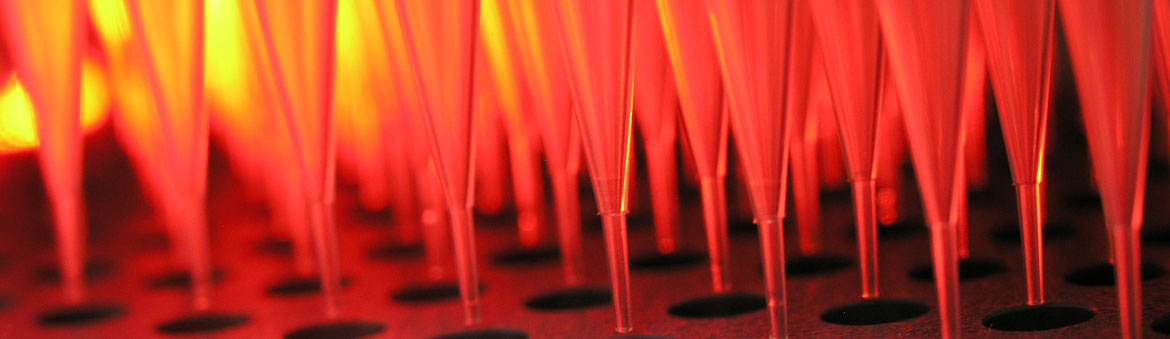
Microplate and pipettor tip cleaning
Microplate and pipettor tip cleaning technology is transforming laboratory sustainability. The life sciences industry significantly impacts the environment, consuming more resources than office spaces and generating vast plastic waste. However, laboratories are shifting priorities towards sustainability. With global initiatives encouraging eco-friendly practices, reducing plastic waste through recycling and reuse is now essential. These changes empower the scientific community to minimise its environmental footprint.
Annually, laboratories contribute 5.5 million tonnes of waste. Plastic pollution remains a pressing global crisis, with production doubling in the last two decades while recycling efforts lag behind. Shockingly, only 9% of all plastic produced is recycled, while 22% is mismanaged. Every year, 4-12 million tonnes of plastic enter our oceans, a figure expected to double within 20 years. Microplastics have infiltrated our food supply and even human bloodstreams.
To ensure a sustainable future, we must take decisive action today. IonField Systems champions plasma cleaning technology as a scientifically, ecologically, and economically viable solution.
Our mission is to help laboratories enhance throughput, cut operational costs, and advance their green initiatives through cutting-edge plasma technology.
Science plays a crucial role in solving these challenges, but it must evolve toward sustainability to make a lasting impact.
Beyond cost savings in procurement, shipping, and disposal, reusing pipette tips and microplates significantly reduces a laboratory's carbon footprint and overall environmental impact.
By implementing protocols that integrate IonField products, laboratories can take a crucial step toward sustainability. We are committed to supporting our customers in achieving their environmental goals.
Annually, laboratories contribute 5.5 million tonnes of waste. Plastic pollution remains a pressing global crisis, with production doubling in the last two decades while recycling efforts lag behind. Shockingly, only 9% of all plastic produced is recycled, while 22% is mismanaged. Every year, 4-12 million tonnes of plastic enter our oceans, a figure expected to double within 20 years. Microplastics have infiltrated our food supply and even human bloodstreams.
To ensure a sustainable future, we must take decisive action today. IonField Systems champions plasma cleaning technology as a scientifically, ecologically, and economically viable solution.
Our mission is to help laboratories enhance throughput, cut operational costs, and advance their green initiatives through cutting-edge plasma technology.
Science plays a crucial role in solving these challenges, but it must evolve toward sustainability to make a lasting impact.
Laboratories hold the power to lead this transformation
Our proprietary plasma-based cleaning systems utilise ambient air plasma to not only remove contaminants but eliminate them at the molecular level. This innovative process allows laboratories to reuse plastics previously considered single-use.Beyond cost savings in procurement, shipping, and disposal, reusing pipette tips and microplates significantly reduces a laboratory's carbon footprint and overall environmental impact.
By implementing protocols that integrate IonField products, laboratories can take a crucial step toward sustainability. We are committed to supporting our customers in achieving their environmental goals.
IonField Automated Microplate Cleaning System
Wildcat is proud to offer IonField's microplate cleaning solutions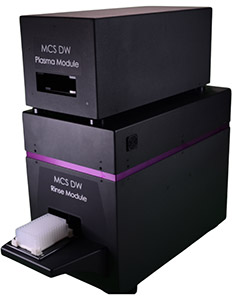
The PurePLATE and PurePLATE Max systems enable microplate reuse, significantly benefiting the environment.
This user-friendly, low-waste system harnesses cold air plasma technology. By converting room air into a cool plasma, the system initiates rapid oxidation, efficiently cleaning microplates.
Each system includes two key modules: the Rinse Module and the Plasma Module.
Rinse Module
The Rinse Module features two controlled-pressure wash manifolds for a rapid, liquid-controlled pre-wash. Using a customised centrifugal process, the plate is spun at up to 1500 RPM to remove cleaning solutions, preparing it for plasma treatment.The system offers application-specific intensity adjustments via the main control interface.
Plasma Module
After rinsing, the microplate enters the Plasma Module, where residual moisture aids in achieving optimal plasma treatment results.Plasma streamers cover the entire plate surface, reaching every corner. The ionised air effectively eliminates all adhered materials.
This efficient process cleans plates in approximately 60 seconds, successfully removing DNA, RNA, siRNA, mRNA, proteins, enzymes, complete organisms, viral particles, and more.
Processes 96- or 384-wells as standard, with higher densities available upon request.

Environmental Impact
Microplate reuse should be a priority for all laboratories.
Independent research by Zühlke compared single-use and reusable microplates. Findings highlight substantial CO² savings achievable with IonField's plasma cleaning system.
Each single-use microplate carries an estimated 0.55kg CO² footprint. However, by reusing plates just five times, this footprint drops to 0.3kg, and further reuse lowers it to 0.18kg per use. Optimal efficiency is achieved at ten reuses, though plates can be reused far beyond that.
A laboratory using 200 microplates, cleaned and reused 50 times, could offset up to 10 metric tonnes of CO² using IonField plasma technology.
Reusing laboratory consumables is the most impactful way to reduce waste while offering significant financial savings.
Automated Pipette Tip Cleaning System
Wildcat is proud to offer IonField's Pipette Tip Cleaning Systems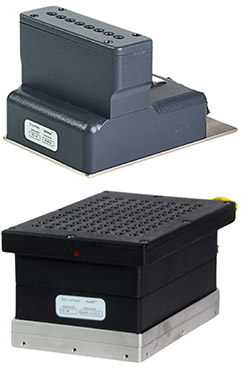
The PureTIP and PureTIP Plus systems enable the reuse of manual and automated pipette tips, significantly reducing plastic waste.
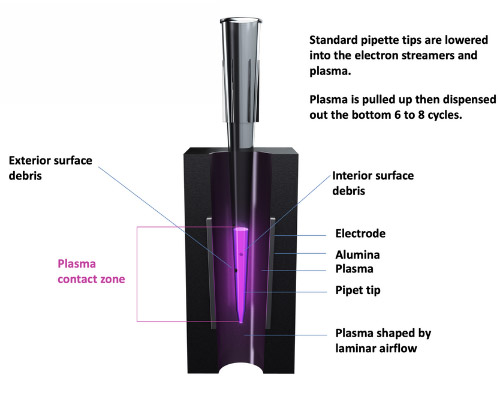
This low-waste, easy-to-use system employs cold air plasma to create an oxidation reaction that eliminates contaminants.
IonField offers two on-deck modules, available in both linear and 96/384 liquid handler formats.
Both modules utilise the same cold air plasma technology as the PurePLATE system.
Using liquid handler wash processes, the Tip Charger modules occupy a single on-deck plate location. Activation occurs via self-start actuation when pipette tips enter the cleaning module. Plasma is then generated and drawn through the tip using aspirate and dispense commands, ensuring thorough internal and external cleaning.
Plasma streamers envelop the tip, fully decontaminating its surface.
This efficient process takes approximately 30 seconds to prepare pipette tips for reuse.
The system effectively removes DNA, RNA, siRNA, mRNA, proteins, enzymes, complete organisms, and viral particles.
Plasma streamers envelop the tip, fully decontaminating its surface.
This efficient process takes approximately 30 seconds to prepare pipette tips for reuse.
The system effectively removes DNA, RNA, siRNA, mRNA, proteins, enzymes, complete organisms, and viral particles.
Environmental Impact
Reusing disposable pipette tips is an essential step toward sustainability.
With today's advanced technologies, reducing single-use plastic waste is not just possible—it's necessary.
Independent research by Zühlke compared single-use and reusable pipette tips. The findings clearly demonstrate the significant CO² savings achieved with IonField's cleaning technology.
Each single-use microplate has a CO² footprint of 0.55kg. However, by reusing a plate five times, the footprint reduces to 0.3kg, dropping further to 0.18kg per use. Beyond ten uses, the footprint stabilises, but plates can be reused far beyond that.
Reusing lab consumables is the most effective way to cut waste while achieving cost savings.
For more details, to schedule a Teams call, or for pricing inquiries, please email us.